Rugby Leg Profile Estimator
Curious about what kind of legs you need for the pitch? Enter your stats to find your optimal rugby role and the specific training stimulus required to build those powerful quads and glutes.
Your Stats
Your Rugby Leg Profile
Select options above and click analyze.
--
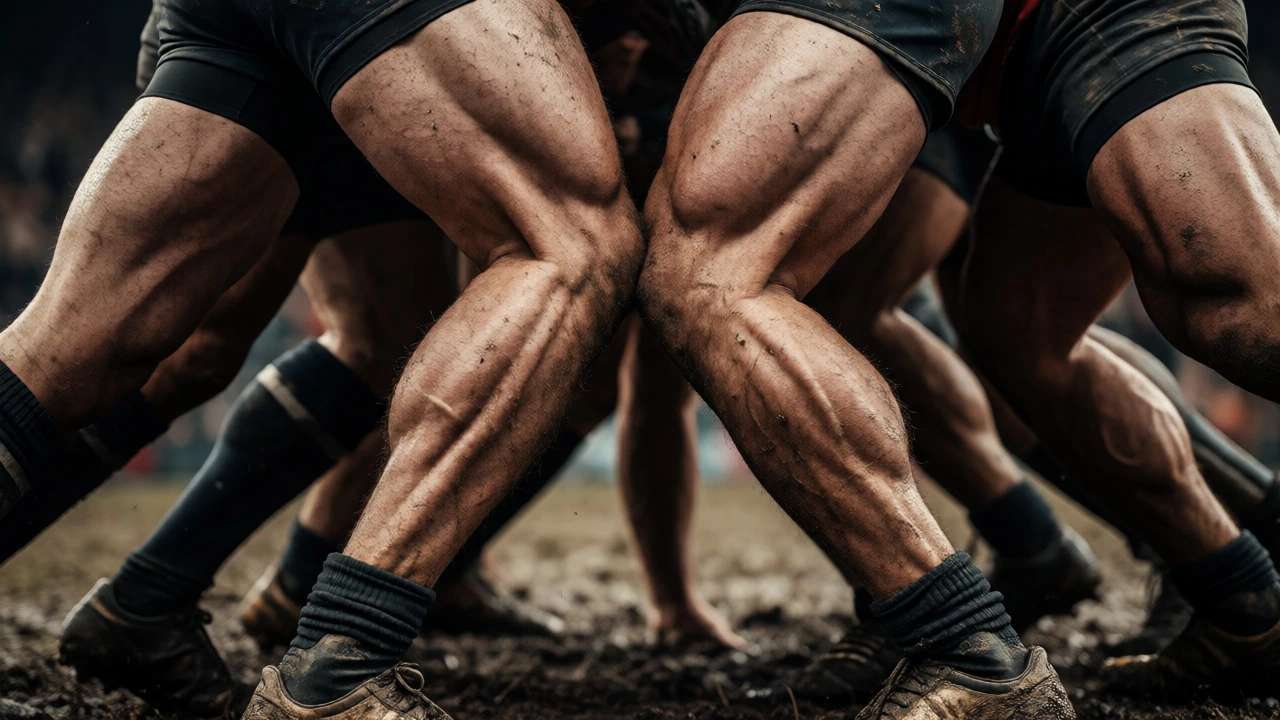
You’ve seen them on TV. Massive thighs, calves that look like they could crush a watermelon, and glutes built for war. It’s not just a stereotype; rugby players are genetically gifted, but their massive leg muscles are primarily the result of specific, high-intensity functional training and biomechanical demands. You might wonder if it’s all genetics or if you can build those guns yourself. The answer lies in the brutal physics of the sport.
The Physics of Impact: Why Mass Matters
Rugby is a collision sport. When two players hit each other at full speed, the laws of physics take over. Specifically, momentum equals mass times velocity. If you want to stop a forward charging at you, you need more mass or more force behind your own stance. This isn't about looking good in shorts; it's about survival and dominance.
Think about a scrum. Eight forwards from one team push against eight from another. The entire weight of sixteen men is transferred through the spine and into the ground via the feet and legs. If your legs aren't strong enough to anchor that force, you slide backward. Simple as that. The quadriceps and hamstrings act as shock absorbers and power generators simultaneously. They have to handle immense compressive loads without buckling.
| Position | Primary Leg Demand | Typical Training Focus | Muscle Type Dominance |
|---|---|---|---|
| Props & Locks (Forwards) | Static stability, heavy pushing, anchoring | Squats, Deadlifts, Sled Pushes | Hypertrophy & Max Strength |
| Wingers & Fullbacks (Backs) | Explosive acceleration, top-end speed | Sprints, Plyometrics, Lunges | Type II Fast-Twitch Fibers |
| Flankers & Number 8 | Hybrid: tackling, rucking, running | Circuit training, Heavy Squats, Agility | Mixed Hypertrophy & Power |
Functional Hypertrophy vs. Bodybuilding
Here is where people get confused. A bodybuilder trains for size. A rugby player trains for function, and size happens as a side effect. But let’s be clear: the size is necessary. You cannot produce elite-level force with small limbs. Force production requires cross-sectional area in the muscle fibers.
Rugby training emphasizes compound movements. We’re talking heavy barbell squats, deadlifts, and lunges. These exercises recruit multiple muscle groups at once. Your quads, hamstrings, glutes, and calves all work together to stabilize your torso while moving a heavy load. This creates a hormonal response-specifically testosterone and growth hormone release-that promotes overall muscle growth, particularly in the lower body because these muscles are large and heavily recruited.
Unlike a marathon runner who needs lean efficiency, a rugby player needs armor. Thick skin doesn’t help much when someone drives a shoulder into your thigh, but thick muscle does. It protects bones and organs and provides the leverage needed to lift opponents off the ground during tackles.
The Tackle: Where Legs Meet Reality
Consider the tackle. It is the most fundamental skill in rugby. To tackle effectively, you must drive through the opponent using your legs. If you rely on your upper body alone, you’ll bounce off. Proper technique involves bending the knees, getting low, and driving upward and forward with the legs.
This action places enormous stress on the posterior chain-the back of your legs. Hamstrings and glutes do the heavy lifting here. Repeatedly performing this motion hundreds of times per week causes micro-tears in the muscle fibers. The body repairs these tears stronger and thicker. Over years of professional play, this repetitive trauma leads to significant hypertrophy. It’s essentially resistance training disguised as gameplay.
Also, consider the ruck. After a tackle, players bind onto bodies and push. This requires isometric strength-holding a position under pressure. Isometric holds build dense, hard muscle. That’s why rugby players’ legs don’t just look big; they look solid. There’s little flab because the muscle density is incredibly high.

Genetics and Selection Bias
We can’t ignore nature. Elite rugby pathways often select for certain physical traits early on. Young athletes with naturally larger frames and higher proportions of fast-twitch muscle fibers are often steered toward forward positions. Fast-twitch fibers have a greater potential for growth than slow-twitch fibers. So, yes, many pro players start with a genetic advantage.
However, genetics only open the door. The room inside is furnished by training. Take a look at players who started smaller. Many backs, who tend to be lighter, still develop powerful legs because sprinting is explosive. Sprinting is essentially heavy resistance training for your legs. Every stride puts up to three times your body weight through your knee joints. Doing that repeatedly builds serious quad and hamstring mass.
Nutrition: Fueling the Machine
You can’t build massive legs on a diet of lettuce. Professional rugby players consume between 4,000 and 6,000 calories a day. That’s a lot of fuel. But it’s not just about quantity; it’s about protein intake. Most pros aim for 1.6 to 2.2 grams of protein per kilogram of body weight daily. This ensures that the muscle damage from training gets repaired and rebuilt bigger.
Carbohydrates also play a crucial role. Glycogen stores in the muscles give them volume and fullness. Depleted glycogen makes muscles look flat. Full glycogen makes them look round and pumped. Since rugby involves repeated bursts of high-intensity effort, carb-loading is essential for performance and appearance.

Can You Get Rugby Legs Without Playing?
Absolutely. You don’t need to join a club to build powerful legs. The key is mimicking the stimulus. Here is a simple breakdown:
- Heavy Compound Lifts: Focus on Back Squats and Romanian Deadlifts. Go heavy. Low reps (3-5) build strength; moderate reps (8-12) build size.
- Unilateral Work: Bulgarian Split Squats are fantastic. They mimic the single-leg stability required in running and cutting.
- Plyometrics: Box jumps or depth jumps train explosive power. This helps convert strength into speed.
- Sled Drives: If you have access to a gym with a sled, push it. It’s the closest thing to a scrum or ruck you’ll find outside the field.
Consistency matters more than intensity initially. Rugby players have been doing this for years. Give it six months of dedicated lower-body focus, and you’ll see changes.
Common Misconceptions About Big Legs
Some people think big legs mean slow. Not true. Look at the fastest wingers in the world-they have huge quads. Speed comes from force application into the ground. Bigger legs can apply more force, which means faster acceleration. The myth that "big muscles make you slow" applies mostly to excessive flexibility loss or poor conditioning, not raw size.
Another misconception is that cardio kills gains. Rugby players do plenty of cardio, but it’s usually interval-based. Steady-state jogging might burn some muscle, but high-intensity intervals preserve it. In fact, the metabolic demand of rugby keeps body fat low, making the muscle definition pop even more.
Do all rugby players have big legs?
No, not all. Forwards generally have significantly larger legs due to the static power demands of scrums and rucks. Backs, especially wingers, may have leaner but highly defined legs optimized for speed rather than pure mass. However, all elite players possess well-developed lower bodies compared to the average person.
Is it better to squat heavy or light for rugby legs?
Both are important. Heavy squats (low reps) build maximum strength, which is crucial for contact situations. Lighter, higher-rep squats build muscular endurance and hypertrophy (size). A balanced program includes both to ensure you can exert force and sustain it throughout an 80-minute game.
Why do my legs hurt after watching rugby highlights?
That’s empathy! Watching impacts triggers mirror neurons. But seriously, rugby players suffer from delayed onset muscle soreness (DOMS) regularly. Their legs are constantly recovering from micro-trauma caused by collisions and sprints. Rest days are critical for them to rebuild that tissue.
Does playing rugby make you taller?
No, playing rugby won’t increase your bone length after puberty. However, strong legs improve posture and spinal alignment, which can make you appear slightly taller. Additionally, height is often selected for in locks and second rows, so tall players are common in those positions, creating a correlation bias.
What is the best exercise for building rugby-ready calves?
Standing calf raises are good, but plyometric exercises like jump rope and box jumps are better for rugby. Calves need to absorb impact and generate explosive push-off. High-volume jumping drills build the tendon stiffness and muscle responsiveness needed for quick direction changes on the pitch.