
Rugby Evolution & Trivia
Scroll down or click cards to explore the true history behind the sport.
Test Your Knowledge
Loading...
Quiz Complete!
You scored 0 out of 0
Picture this: it’s a cold November day in 1823. A muddy football match is underway at Rugby School in England. Suddenly, a young student named William Webb Ellis picks up the ball and runs with it toward the goalposts. Legend says he shouted, "Play the ball!" before sprinting past defenders. That moment, according to tradition, invented rugby.
But here’s the twist: historians largely agree that story is probably fake. Or at least, heavily exaggerated. So who really created the sport we know today? Was it one boy’s spontaneous act of rebellion, or was it a slow evolution shaped by teachers, rule-makers, and cultural shifts? Let’s dig into the actual history.
The Myth of William Webb Ellis
We all love a good underdog story, and William Webb Ellis fits the bill perfectly. He wasn’t a famous athlete. He wasn’t even particularly known for sports during his time at school. Born in 1806, Webb Ellis attended Rugby School from 1815 to 1826. He later became a clergyman and died in 1872, largely forgotten by history-until the rugby world decided he needed credit.
In 1848, two decades after the alleged incident, a former pupil named Francis Marshall wrote a letter claiming he remembered Webb Ellis picking up the ball. This single account sparked the myth. By 1891, the RFU (Rugby Football Union) officially recognized Webb Ellis as the founder. They even commissioned a statue of him holding the ball aloft, which now stands outside Twickenham Stadium in London.
Yet, no contemporary records from 1823 mention the event. No diaries, no newspaper clippings, no letters. It’s suspiciously silent for such a groundbreaking moment. Most modern historians believe the story was fabricated to give rugby a heroic origin tale, similar to how basketball credits James Naismith or baseball credits Abner Doubleday (another dubious claim).
What Actually Happened at Rugby School?
To understand where rugby came from, you have to look at what kids were playing before 1823. In English public schools like Rugby School, football games were chaotic. There were no standardized rules. Each school had its own version. Some allowed handling the ball; others didn’t. Some let players trip opponents; others banned physical contact entirely.
At Rugby School, students played a game called “football,” but it looked nothing like soccer. Players could kick, carry, or pass the ball. They could also tackle each other. The objective was simple: get the ball to the other side of the field. But without written rules, every match played differently depending on who refereed it.
This inconsistency caused problems. Disputes broke out constantly. Teachers struggled to control matches. And when students moved between schools, they couldn’t play together because their versions of football clashed. Something had to change.
The Codification of Rugby Rules
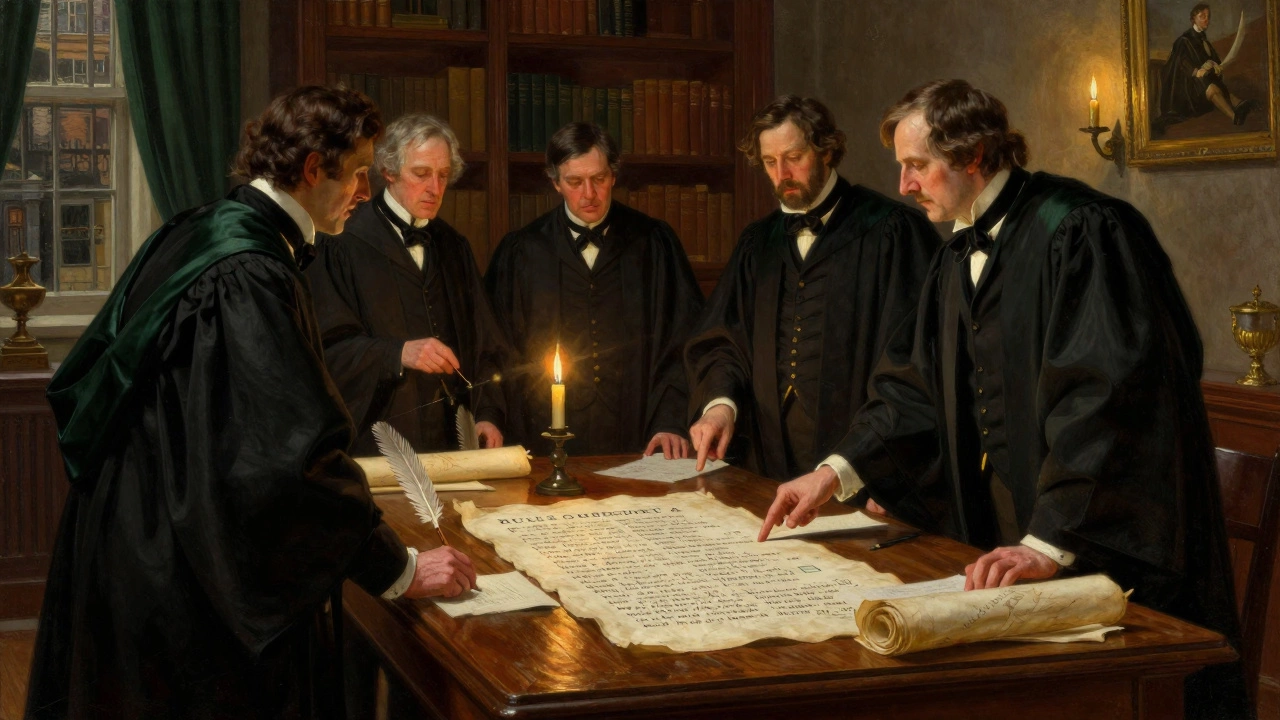
If William Webb Ellis didn’t invent rugby, then who did? The answer isn’t a person-it’s a committee. In 1845, teachers at Rugby School drafted the first official set of rules for their version of football. These weren’t perfect, but they provided structure. For the first time, there was clarity on what constituted a foul, how scoring worked, and whether carrying the ball was allowed.
Then came the big split. In 1863, representatives from various schools met in London to create unified football rules. Two factions emerged. One group wanted to ban handling the ball completely-they became the founders of association football (soccer). The other group insisted on keeping the ability to carry and pass the ball forward. They walked away and formed the Rugby Football Union in 1871.
That decision defined rugby forever. From that point on, rugby evolved separately from soccer. It developed its own identity, culture, and global following. While soccer spread quickly through Europe and South America, rugby found strongholds in Britain, Australia, New Zealand, South Africa, and France.
How Rugby Spread Around the World
Rugby didn’t stay confined to England. British soldiers, sailors, and colonists carried the game overseas. In the late 1800s, rugby took root in places like Fiji, Samoa, Tonga, and eventually countries like Argentina and Japan. Today, over 120 nations participate in international rugby competitions.
New Zealand’s All Blacks became synonymous with excellence in the sport. Their haka-a traditional Māori war dance-has become iconic worldwide. South Africa’s Springboks won multiple Rugby World Cups, cementing rugby’s status as a major global competition. Even smaller nations like Georgia and Samoa compete fiercely against powerhouses.
The sport also diversified. Rugby union remained the dominant form, but rugby league emerged in northern England in 1895 due to disputes over player payments. Both codes share common roots but differ significantly in rules, team size, and strategy. Understanding these distinctions helps explain why some fans prefer one version over another.
Key Differences Between Rugby Union and Rugby League
| Feature | Rugby Union | Rugby League |
|---|---|---|
| Players per Team | 15 | 13 |
| Tackles Allowed | Unlimited | Six tackles per possession |
| Scoring System | Trial = 5 pts, Conversion = 2 pts, Penalty = 3 pts | Trial = 4 pts, Conversion = 2 pts, Penalty = 2 pts |
| Professional Status | Became professional in 1995 | Turned professional earlier, in 1895 |
| Global Popularity | More widespread internationally | Stronger in UK, Australia, Pacific Islands |

Why Does the Origin Matter Today?
You might wonder why we care about who invented rugby. After all, people still watch thrilling matches regardless of historical accuracy. But knowing the true origins gives context to modern traditions. It explains why rugby values teamwork, discipline, and respect-traits emphasized by early educators at Rugby School.
It also highlights how sports evolve organically. Unlike inventions designed in laboratories, rugby grew naturally from playground chaos into a structured global phenomenon. Its journey mirrors broader social changes: industrialization, colonial expansion, and shifting attitudes toward athleticism and professionalism.
Understanding this background enriches your appreciation of the game. When you see a scrum unfold or witness a last-minute drop goal, remember that centuries of trial and error led to those moments. Rugby isn’t just entertainment-it’s living history.
Frequently Asked Questions About Rugby’s Origins
Did William Webb Ellis really invent rugby?
Probably not. While legend credits William Webb Ellis with inventing rugby in 1823 by picking up the ball during a match, there’s no solid evidence supporting this claim. Historians believe the story was created later to provide a heroic origin tale for the sport.
When were the first official rugby rules written?
The first formal rules for rugby were established in 1845 by teachers at Rugby School. These rules laid the foundation for organized play and helped distinguish rugby from other forms of football.
How did rugby split from soccer?
In 1863, representatives from different schools tried to unify football rules. Those who supported banning handball formed the basis of soccer. Others who wanted to keep carrying and passing the ball left and founded the Rugby Football Union in 1871.
Where is rugby most popular today?
Rugby enjoys massive popularity in countries like New Zealand, South Africa, Australia, England, France, and Wales. Smaller nations like Fiji, Samoa, and Georgia also have passionate followings and competitive teams.
What’s the difference between rugby union and rugby league?
Rugby union features 15 players per team and unlimited tackles, while rugby league uses 13 players and limits possessions to six tackles. Scoring systems also differ slightly, with union awarding more points for tries.