
Personalized Workout Routine Generator
Your Customized Routine
You walk into the gym. The air smells like rubber mats and determination. You look around: someone is doing deadlifts with perfect form, another person is sprinting on a treadmill, and a third is staring at their phone while holding dumbbells. What do you do? If you’re searching for "the best" gym workout routine, you’ve likely hit a wall of conflicting advice online. One influencer says train every day; another says rest more. One swears by bodybuilding splits; another champions CrossFit.
Here is the truth: there is no single "best" routine for everyone. The best routine is the one that aligns with your specific goals, fits your recovery capacity, and-most importantly-that you will actually stick to. However, science does point us toward certain principles that work better than others for building muscle, burning fat, and improving overall health. Let’s cut through the noise and build a plan that actually works.
The Foundation: Progressive Overload
Before we talk about sets, reps, or which machine to use, we need to address the engine behind all results: progressive overload. This is the non-negotiable rule of fitness. It means gradually increasing the demand placed on your body over time. Without it, you are just exercising, not training.
You might think this means adding weight to the bar every session. While that is part of it, progressive overload is broader. You can increase intensity by:
- Adding weight: Going from 50 lbs to 55 lbs on the bench press.
- Increasing reps: Doing 10 reps instead of 8 with the same weight.
- Improving form: Slowing down the eccentric (lowering) phase to increase time under tension.
- Reducing rest: Cutting rest periods from 90 seconds to 60 seconds to boost metabolic stress.
If you aren’t tracking your workouts, you aren’t progressing. Grab a notebook or an app. Write down what you did last week. Beat it slightly this week. That is how you transform your physique.
Choosing Your Split: Frequency vs. Volume
One of the biggest debates in the gym is how often to train each muscle group. Should you do a "bro-split" (chest on Monday, back on Tuesday) or a full-body routine? Research suggests that hitting a muscle group twice a week is generally superior for most natural lifters compared to once a week. Here are the three most effective structures based on your experience level and schedule.
| Split Type | Best For | Frequency per Muscle | Recovery Demand |
|---|---|---|---|
| Full Body | Beginners & busy schedules | 2-3 times/week | Moderate |
| Upper/Lower | Intermediate lifters | 2 times/week | High |
| PPL (Push/Pull/Legs) | Advanced & high volume lovers | 2 times/week (6-day cycle) | Very High |
The Full-Body Routine
This is often the best starting point. You train three days a week (e.g., Monday, Wednesday, Friday). Each session covers major movement patterns: a squat pattern, a hinge pattern, a push, and a pull. Because you spread the volume out, you recover well between sessions. It’s efficient and builds a solid foundation of strength.
The Upper/Lower Split
As you get stronger, full-body sessions become longer and more taxing. An upper/lower split allows you to focus more intensely on specific areas without burning out your entire system. You might train four days a week: Upper A, Lower A, Rest, Upper B, Lower B, Rest, Rest. This offers a great balance of frequency and recovery.
Push/Pull/Legs (PPL)
PPL groups muscles that work together. Push exercises include chest, shoulders, and triceps. Pull exercises cover back and biceps. Legs handle quads, hamstrings, and glutes. This split is popular among bodybuilders because it allows for high volume per muscle group. However, it requires six days of training if you want to hit each muscle twice a week, which isn’t sustainable for everyone.
Selecting the Right Exercises
Not all exercises are created equal. To build a resilient, aesthetic, and functional body, you should prioritize compound movements over isolation exercises. Compound lifts recruit multiple joints and muscle groups, allowing you to move more weight and stimulate greater hormonal responses.
Your routine should revolve around these five core movements:
- Squat Pattern: Barbell back squats, front squats, or goblet squats. These target the quadriceps, glutes, and core.
- Hinge Pattern: Deadlifts or Romanian deadlifts (RDLs). These build posterior chain strength (hamstrings and lower back).
- Horizontal Push: Bench press or dumbbell press. Essential for chest development.
- Vertical Pull: Pull-ups or lat pulldowns. Critical for back width and bicep engagement.
- Vertical Push: Overhead press. Builds shoulder strength and stability.
Once you have these bases covered, add accessory work. Think lateral raises for side delts, curls for biceps, and tricep extensions. But remember: accessories support the main lifts; they don’t replace them.
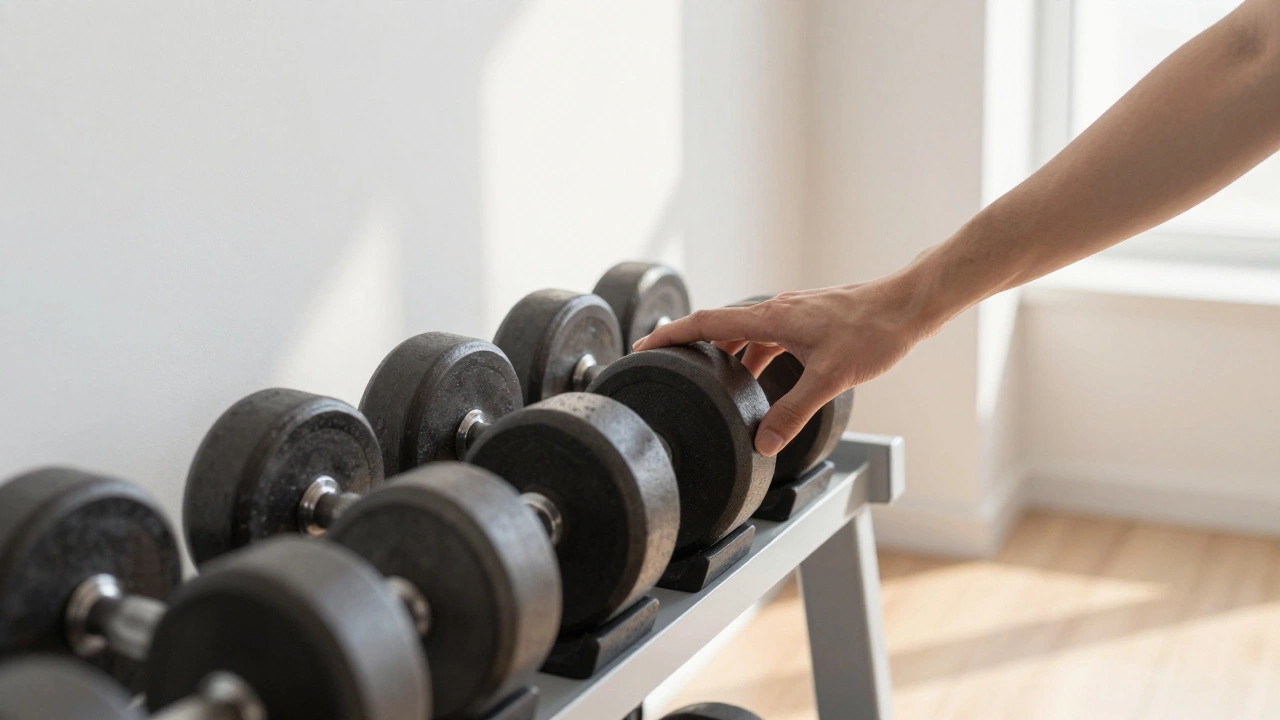
Structuring Your Sets and Reps
How many reps should you do? It depends on your goal, but the difference between strength and hypertrophy (muscle growth) is smaller than people think. Both require heavy loads, but the rep ranges differ slightly.
- Strength Focus (1-5 reps): Use heavier weights (85-95% of your one-rep max). Focus on perfect technique and neural adaptation. This is ideal for powerlifting goals.
- Hypertrophy Focus (6-12 reps): The classic bodybuilding range. It balances mechanical tension and metabolic stress. Most people find this range optimal for muscle growth.
- Muscular Endurance (15+ reps): Lighter weights, higher reps. Useful for finishing touches or rehabilitation, but less efficient for building significant size or strength.
A practical approach for general fitness is to mix these. Do your compound lifts in the 5-8 rep range for strength, and your isolation exercises in the 10-15 rep range for pump and detail. Always leave 1-2 reps in the tank (RPE 7-8) to avoid injury and ensure consistency.
The Role of Cardio and Recovery
You grow when you rest, not when you train. Training breaks down muscle tissue; recovery rebuilds it stronger. If you skip sleep or nutrition, no workout routine will save you. Aim for 7-9 hours of quality sleep per night. This is when human growth hormone peaks and cortisol levels drop.
Cardio also plays a crucial role. It doesn’t have to mean running marathons. Low-intensity steady-state (LISS) cardio, like walking on an incline or cycling lightly, improves cardiovascular health without interfering with strength gains. High-intensity interval training (HIIT) can be added sparingly for calorie burning, but too much HIIT can hinder recovery from heavy lifting.

Nutrition: Fueling the Machine
Your diet dictates whether you gain muscle, lose fat, or maintain weight. There is no magic food, but there are key macronutrients to track:
- Protein: The building block of muscle. Aim for 1.6 to 2.2 grams of protein per kilogram of body weight daily. Sources include chicken, fish, eggs, tofu, and Greek yogurt.
- Carbohydrates: Your primary energy source for intense workouts. Don’t fear carbs. Rice, oats, potatoes, and fruits fuel your performance.
- Fats: Essential for hormone production, including testosterone. Include avocados, nuts, olive oil, and fatty fish.
If you want to build muscle, eat in a slight caloric surplus (200-300 calories above maintenance). If you want to lose fat, eat in a deficit. But never crash diet while training hard; you’ll lose muscle along with fat.
Avoiding Common Pitfalls
Even with the best routine, mistakes can derail progress. Watch out for these common traps:
- Ego Lifting: Adding weight before mastering form. This leads to injury, not gains. Leave your ego at the door.
- Inconsistency: Working out hard for two weeks, then skipping a month. Consistency beats intensity over time.
- Ignoring Mobility: Tight hips and shoulders limit your range of motion. Spend 5-10 minutes stretching or foam rolling after each session.
- Overcomplicating: Trying fancy programs with complex supersets and drop sets. Master the basics first. Simple routines done consistently yield better results than complex ones abandoned quickly.
Sample Weekly Schedule for Beginners
If you’re still unsure where to start, here is a simple, effective full-body routine to follow for your first 8-12 weeks. Perform this three days a week, with at least one rest day between sessions.
Day 1:
- Goblet Squats: 3 sets of 8-10 reps
- Dumbbell Bench Press: 3 sets of 8-10 reps
- Bent-Over Rows: 3 sets of 10-12 reps
- Plank: 3 sets of 30-60 seconds
Day 2:
- Romanian Deadlifts: 3 sets of 8-10 reps
- Overhead Press: 3 sets of 8-10 reps
- Lat Pulldowns: 3 sets of 10-12 reps
- Lunges: 3 sets of 10 reps per leg
Day 3:
- Leg Press: 3 sets of 10-12 reps
- Incline Dumbbell Press: 3 sets of 10-12 reps
- Seated Cable Rows: 3 sets of 10-12 reps
- Side Lunges: 3 sets of 10 reps per leg
After 12 weeks, reassess. Are you getting stronger? If yes, keep going. If you’ve plateaued, consider switching to an Upper/Lower split to increase volume and frequency. Remember, the best routine is the one you enjoy enough to repeat.
How long should I wait before seeing results?
Most people notice changes in strength within 2-4 weeks due to neural adaptations. Visible muscle changes typically take 8-12 weeks of consistent training and proper nutrition. Fat loss depends heavily on your caloric deficit, but aim for 0.5-1% of body weight per week for sustainable results.
Can I build muscle and lose fat at the same time?
Yes, especially if you are new to training or returning after a break. This is called body recomposition. Maintain a slight caloric deficit or eat at maintenance while consuming high protein and lifting heavy. Advanced lifters may find it easier to bulk and cut separately.
Is it okay to train every day?
For beginners, no. Your body needs rest to repair muscle tissue. Training every day increases the risk of overtraining and injury. Even advanced athletes usually incorporate active recovery days. Aim for 3-6 structured workouts per week, with the rest being light activity or complete rest.
Should I focus on cardio or weights first?
It depends on your primary goal. If you want to change your body composition (build muscle/lose fat), prioritize weights. Cardio supports heart health and aids fat loss, but resistance training has a greater impact on metabolism and aesthetics. A balanced approach includes both.
What if I don't have access to a full gym?
You can still achieve great results with minimal equipment. Bodyweight exercises like push-ups, pull-ups (using a bar), squats, and lunges are highly effective. Add resistance bands or kettlebells for variety. The principles of progressive overload still apply: make the movements harder over time by increasing reps, slowing tempo, or reducing leverage.