
Golf Shot Identifier Tool
Shot Parameters
Enter your shot details to see what it's called.
You step up to the tee box, grip your driver, and swing. You hit the ball. But what do you actually call that action? If you are new to the game, the language of golf is a precision sport played on a course with holes where players use clubs to hit a ball into the hole in as few strokes as possible can feel like a foreign dialect. There isn't just one word for hitting the ball. Depending on the club used, the trajectory, the distance, and even the outcome, every single strike has a specific name.
Understanding these terms is crucial. It helps you communicate with your caddie or playing partners, follow professional tournaments on TV, and most importantly, choose the right strategy for your next move. This guide breaks down exactly what each golf shot is called, from the powerful drive off the tee to the delicate putt on the green.
The Basics: What Do We Call a Hit?
At its simplest level, any time you strike the ball with a club, it is called a stroke. However, we rarely say "I took a stroke." Instead, we describe the type of shot based on the context.
- Drive: This is the first shot taken from the tee box at the start of a hole. It is almost always hit with a driver (1-wood) or a fairway wood. The goal is maximum distance down the fairway.
- Fairway Wood: A shot hit from the fairway using a wood club (like a 3-wood or 5-wood). This is often used when you need a long shot but don't have the lie for an iron.
- Iron Shot: Any shot hit with an iron club. These are typically used for approach shots onto the green. They offer more control and accuracy than woods but less distance.
- Wedge Shot: A short-distance shot hit with a wedge (pitching wedge, gap wedge, sand wedge, or lob wedge). These are used for high-lofted shots around the green or out of bunkers.
- Putt: The rolling shot made on the green using a putter. The goal is to roll the ball into the hole.
If you hear someone say they "drove" the ball, they mean they hit it with a driver. If they "putted" it, they rolled it on the green. These verbs are derived directly from the noun forms of the shots.
Straight Shots vs. Curved Shots
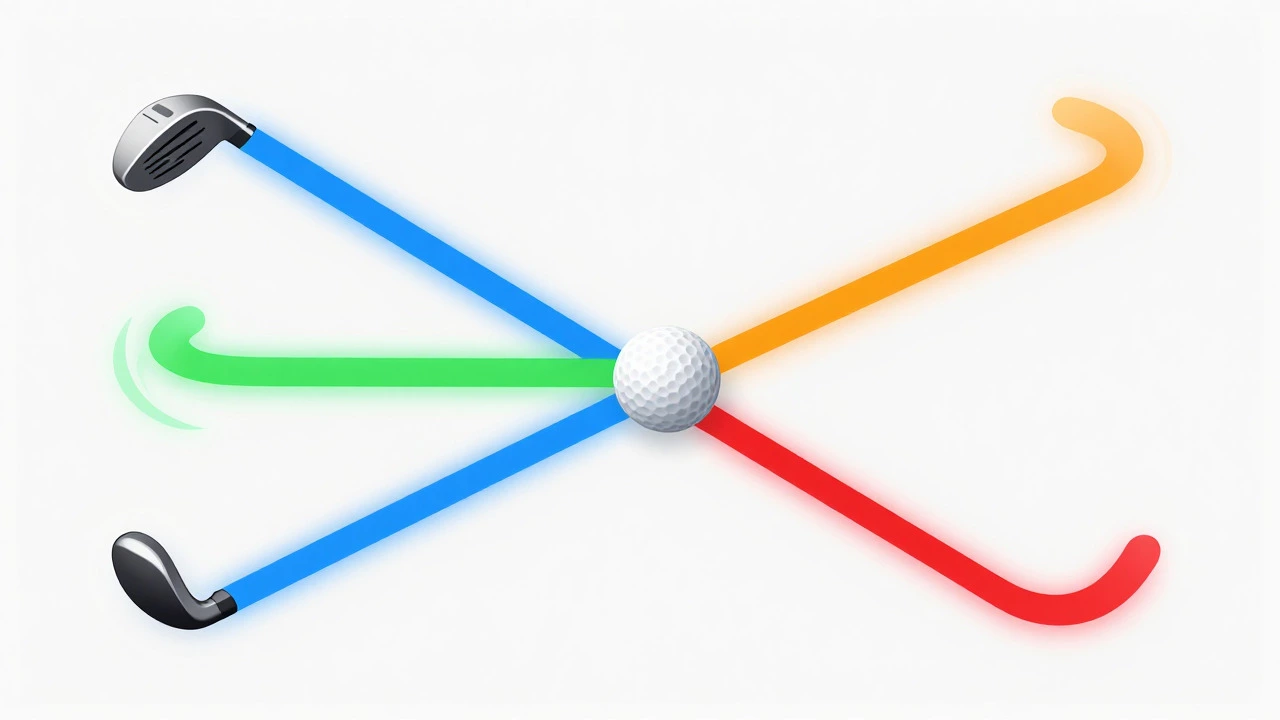
In an ideal world, every golfer would hit the ball perfectly straight toward the target. In reality, the ball often curves due to the angle of the clubface and the path of the swing. These curved shots have very specific names that you will hear constantly.
| Shot Name | Direction of Curve | Cause (For Right-Handers) | Difficulty Level |
|---|---|---|---|
| Straight | No curve | Clubface square to target line; swing path along target line | Low (Ideal) |
| Hook | Sharp left curve | Clubface closed relative to swing path; strong grip | High (Uncontrolled) |
| Slice | Sharp right curve | Clubface open relative to swing path; weak grip or over-the-top swing | High (Common beginner error) |
| Draw | Gentle left curve | Clubface slightly closed relative to swing path | Medium (Desired by pros) |
| Fade | Gentle right curve | Clubface slightly open relative to swing path | Medium (Desired for control) |
A hook is a severe curve to the left for a right-handed player. It happens when the clubface is closed at impact relative to the swing path. It can be dangerous because it often flies fast and hard to find. Conversely, a slice curves sharply to the right. This is the most common mistake for beginners. It usually results from an "over-the-top" swing motion where the club approaches the ball from outside the target line.
However, not all curves are bad. Professional golfers intentionally shape their shots. A draw is a controlled, gentle curve to the left. It tends to roll more upon landing, adding distance. A fade is a controlled, gentle curve to the right. It lands softer and stops quicker on the green, offering more precision. Learning to differentiate between a slice (bad) and a fade (good) is a major milestone in your golf journey.
Short Game Terminology
The "short game" refers to all shots taken within 100 yards of the hole. This is where most amateur golfers lose strokes. The terminology here becomes very specific based on the height and spin of the ball.
- Pitch: A high-arcing shot played from close to the green. The ball spends more time in the air than on the ground. It is designed to land softly and stop quickly.
- Chip: A low-running shot. The ball hits the ground almost immediately and rolls toward the hole. This is used when there is little obstacle between you and the green.
- Lob: An extremely high, soft shot with maximum spin. It is used when you need to clear an obstacle (like a bunker or tree) and stop the ball almost instantly upon landing. This requires a lob wedge.
- Bump and Run: Similar to a chip, this involves taking a divot behind the ball and letting it run out on the green. It is a reliable shot for windy conditions.
If you are standing in a bunker (sand trap), the shot is simply called a bunker shot or a sand wedge shot. The technique involves hitting the sand behind the ball rather than the ball itself, using the explosion of sand to lift the ball out.
Shots Based on Outcome and Position
Sometimes, the name of the shot is defined by where the ball ends up or how well it was executed.
A birdie, eagle, or par are scores, not shots, but they dictate the type of shot you need. For example, if you are two shots under par on a par-5, you might attempt a risky hero shot-an aggressive play to reach the green in fewer strokes.
When you hit the ball into a difficult position, such as thick rough (long grass) or behind a tree, you may need to hit a punch shot. This is a low-trajectory shot designed to get the ball out of trouble without needing much clearance. You keep your hands ahead of the ball and take a compact swing.
If you miss the green entirely and the ball lands in the rough, your next shot is often called a recovery shot. The goal here isn't necessarily to get close to the pin, but to get back to a playable lie, usually the fairway.

Specialized and Rare Shots
As you advance, you will encounter more nuanced terms. A stinger is a very low, penetrating shot hit with an iron, often used by professionals to beat wind. It resembles a drive in trajectory but is hit with an iron for accuracy.
A flop shot is similar to a lob but even higher and softer, requiring a highly lofted wedge and plenty of space behind the ball to operate. It is one of the hardest shots in golf to master.
On the green, if you miss your putt but leave the ball close enough to tap in, it's called a tap-in. If you sink a long putt from off the green, it might be referred to as a chip-in if it was chipped, or a run-up if it was rolled.
Why Knowing These Names Matters
Knowing the difference between a pitch and a chip changes your club selection. A pitch requires a higher-lofted wedge and more wrist hinge. A chip requires a lower-lofted club and minimal wrist movement. If you call everything a "hit," you won't adjust your technique accordingly.
Furthermore, understanding terms like "slice" and "hook" allows you to diagnose your swing flaws. If you consistently slice, you know you need to work on your swing path and face angle. If you hook, you might need to weaken your grip. The vocabulary provides the framework for improvement.
Finally, it enhances the social aspect of the game. When your playing partner says, "Nice draw," you'll know they are complimenting your controlled shot shape, not just calling it a lucky hit. Golf is as much about communication and etiquette as it is about mechanics.
What is the difference between a draw and a hook?
A draw is a controlled, gentle curve to the left (for right-handers) that is intentional and adds distance through roll. A hook is an uncontrolled, sharp curve to the left caused by a closed clubface and inward swing path, often leading to errant shots.
What is a chip shot vs. a pitch shot?
A chip shot is low and runs more on the ground after landing, used when there is little obstacle. A pitch shot is higher in the air, lands softer, and relies more on spin to stop quickly, used when you need to carry an obstacle or stop near the pin.
What is a slice in golf?
A slice is a shot that curves sharply to the right for a right-handed player. It is caused by an open clubface at impact combined with an outside-to-inside swing path. It is the most common fault among beginners.
What is a drive in golf?
A drive is the first shot taken on a hole, hit from the tee box. It is typically played with a driver (1-wood) or fairway wood to achieve maximum distance down the fairway.
What is a stinger shot?
A stinger is a low-trajectory, high-speed shot hit with an iron. It is designed to penetrate through wind and roll out upon landing, offering greater control in adverse weather conditions.